

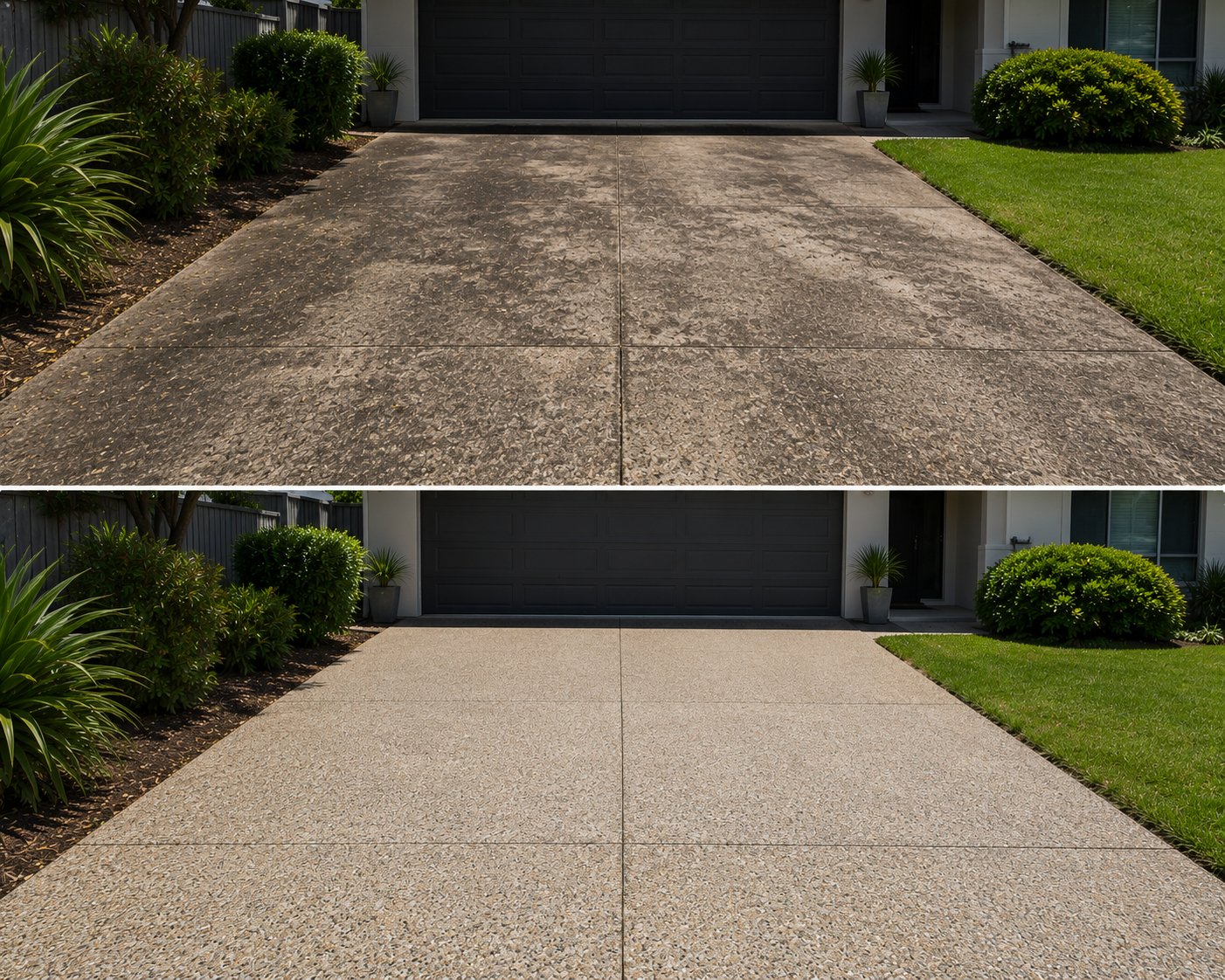
Your driveway is the first thing anyone sees when they pull up to your property. On the Sunshine Coast, it's also one of the surfaces most aggressively attacked by the local climate, subtropical humidity, regular rainfall, and biological growth mean a concrete driveway that looks clean today can be green, black, and slippery within a year if not maintained.
Why Sunshine Coast Driveways Get Dirty So Fast
Concrete is porous. Moisture from rain and humidity sits in the surface, creating perfect conditions for algae, mould, and lichen to establish themselves. Shaded driveways, particularly those under trees, dry more slowly and are significantly worse. The result is the characteristic dark green-to-black discolouration most Sunshine Coast homeowners know well. A garden hose won't remove it. Even a domestic pressure washer typically won't remove it completely, because it clears the surface growth without killing the underlying organism.
The Four Main Driveway Problems
1. Mould and algae
By far the most common issue. Professional pressure cleaning with a commercial surface cleaner removes the growth effectively. For recurring problems, a post-clean biocide treatment slows regrowth significantly. Sealing after cleaning provides an additional barrier.
2. Oil stains
The most challenging problem. Oil penetrates porous concrete quickly, and the older it is, the deeper it's gone. Fresh oil stains (under six months) on unsealed concrete can typically be removed or reduced dramatically with professional degreaser pre-treatment and hot water pressure cleaning. Old stains may be reduced but not fully eliminated, any contractor who promises complete removal on a five-year-old oil stain on unsealed concrete is overselling.
3. Tyre marks
Usually removable with appropriate degreaser application and high-pressure cleaning. Severe tyre marks from burnouts may leave some residual shadow on aged concrete.
4. Rust stains
Rust stains from metal furniture or fittings require specific oxalic acid-based treatments, standard pressure cleaning won't shift them. Results vary depending on how long the stain has been there and how deeply it has penetrated.
DIY vs Professional: The Honest Comparison
A decent domestic pressure washer delivers around 1,500-2,000 PSI. Professional equipment operates at 3,000-4,000 PSI with significantly higher flow rates. More importantly, professional operators use rotary surface cleaners, spinning heads that deliver even, consistent pressure across the surface, rather than a single wand that leaves visible lines. For a small, lightly soiled driveway, DIY can produce an acceptable result. For anything larger, significantly stained, or with oil problems, the difference in outcome is substantial and immediately visible.
Should You Seal After Cleaning?
Yes, in most cases. Sealing a clean driveway reduces organic growth regrowth, makes oil and stain penetration much harder, enhances colour, and makes routine maintenance far easier. A properly sealed driveway typically needs cleaning half as often as an unsealed one in the same conditions. Immediately after professional pressure cleaning is the best time to seal, the surface is open and ready.
How Long Does It Take?
Most residential driveways take 1-2 hours including pre-treatment, surface cleaning, edge detailing, and cleanup. Heavily stained driveways may take up to 3 hours. We give an accurate time estimate in every quote.
Ready to get your driveway restored? Get an instant quote or view our before and after gallery for real results from Sunshine Coast properties.